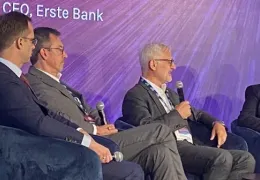
The European Investment Bank lent €759 million in Hungary last year and is looking to support more investment in solar, energy storage and clean technologies. In a conversation with Stefania Ciraolo, Head of the EIB Group Office in Hungary, we asked what it takes for a Hungarian developer to work with the EU bank.
Key Takeaways
- Maturity over ambition: Bring a mature investment project, rather than only an initial idea.
- Start early: Engage with the EIB early in the project’s development and financing process.
- Up to 50%: As a general rule, EIB financing can cover up to 50% of the total investment cost of a project.
- Smaller projects too: Smaller companies and projects can also benefit indirectly from EIB Group support through financial intermediaries and EIF-backed instruments.
For many energy developers in Hungary, project finance means a commercial bank, a grant scheme and equity. The EIB may not always feature in that picture, partly because developers assume that accessing EIB financing is difficult. Miss Ciraolo’s message was different: for sufficiently large and mature projects that are aligned with the EIB’s priorities, it is worth starting a conversation with the Bank at an early stage.
A Bank Owned by 27 Countries and Funded by the Markets
The EIB Group comprises the European Investment Bank and its subsidiary, the European Investment Fund (EIF). The EIB is the EU’s long-term financing institution and is owned by the 27 EU Member States. Founded in 1958 and headquartered in Luxembourg, it operates through a network of offices, including the EIB Group Office in Budapest.
A common misconception, Stefania Ciraolo noted, is that the EIB finances its lending directly from taxpayers’ money. In fact, the Bank raises the bulk of its lending resources on the international capital markets. Its strong credit standing allows it to borrow on favourable terms and pass on the benefits of its financing conditions to eligible projects.
The Member States hold shares in the Bank broadly reflecting their economic weight within the EU. As an EU policy-driven bank, however, the EIB’s objective goes beyond generating a financial return. Its financing aims to support investments that contribute to EU policy objectives and deliver additional economic, social or environmental value.
“Our biggest added value is to help make a project happen,” Miss Ciraolo said.
The EU Climate Bank: Financing Projects and Mobilising Investment
The EIB calls itself the EU climate bank for a concrete reason: climate action and environmental sustainability have become central to its activity. Under its Climate Bank Roadmap, the Bank has substantially increased its support for green investment, while its financing activities are aligned with the goals and principles of the Paris Agreement.
Stefania Ciraolo described the EIB as a project-driven bank. It assesses individual projects and their contribution to EU policy objectives, which include climate action, energy security, innovation, digitalisation, competitiveness, cohesion and other strategic priorities.
On innovation and competitiveness, she highlighted a broader European challenge: Europe generates excellent ideas and technologies, but promising companies can face difficulties obtaining the financing required to scale up successfully in Europe. Supporting European innovation and scale-ups is therefore an increasingly important part of the EIB Group’s role.
Two principles are particularly important:
- Additionality: EIB financing should provide clear added value, for example by improving financing conditions, extending maturities, providing risk-bearing capacity or helping mobilise additional investment.
- Financing alongside other investors: As a general principle, the EIB typically finances up to 50% of a project’s investment cost, helping to mobilise complementary financing from commercial banks, investors, public resources and project sponsors.
In 2025, the EIB Group provided close to €100 billion in new financing, with a substantial proportion supporting green investment. Energy is one of the Group’s major areas of activity, alongside areas such as innovation, infrastructure, SMEs and mid-caps, social infrastructure, water and climate adaptation.
In Hungary, the Bank signed €759 million in financing last year. Smaller companies and projects can also benefit indirectly from EIB Group support through financial intermediaries and EIF-backed instruments.
Solar, Storage and Biogas: What Can Qualify?
Asked whether solar parks and battery energy storage systems (BESS) fit the EIB’s model, Miss Ciraolo stressed that renewable energy and storage are fully aligned with the Bank’s strategic priorities. Other potentially eligible investments include biogas, energy-efficiency improvements in buildings and industrial decarbonisation.
The critical issue is not simply ambition, but project maturity.
“Very often people come with ideas,” she said. “That is a different thing.”
For project financing to progress, a promoter needs to demonstrate that a project is sufficiently developed. Depending on the project, this may include obtaining the necessary permits and securing relevant grid arrangements. The EIB can provide advisory support in appropriate circumstances, but project promoters remain responsible for obtaining the necessary permits and authorisations.
Key parameters include:
- Project size: Direct EIB financing is generally best suited to larger investment projects. For smaller projects and companies, EIB Group financing can be channelled through intermediary banks, funds and other financial institutions.
- EIB financing: As a general rule, EIB financing can cover up to 50% of the total investment cost of a project.
- Eligible investment: The Bank assesses which elements of an investment are eligible for EIB financing and consistent with the relevant EU and EIB policy objectives.
- Capital structure: The remaining financing can come from a combination of commercial lenders, grants, equity or other sources, depending on the project’s financial structure.
- Pricing: Financing terms depend on factors including the borrower, credit risk, maturity and transaction structure. A central objective is to provide financial added value without crowding out market financing.
EU and national grants can also be combined with EIB financing where the relevant rules allow it. This can make the Bank particularly useful in structuring large investments requiring several sources of funding.
An important part of the EIB’s added value is its project appraisal. Its technical, financial, economic, environmental, legal, risk and other specialists assess projects before financing is approved. This due diligence can also provide reassurance to other financiers participating in a project.
Rigorous Appraisal Takes Time
EIB financing involves a thorough appraisal process. Once sufficient project information is available, the Bank assesses the project’s eligibility and justification before proceeding with detailed appraisal.
This can involve technical specialists as well as financial, risk, legal, environmental and compliance experts. Depending on the operation, the project then follows the relevant EIB approval process before financing documentation is signed and funds can be disbursed.
For a major infrastructure or energy investment, however, financing is typically considered well before construction begins. Stefania therefore encourages developers to approach the EIB early enough for the Bank to understand the project and determine whether and how it could contribute.
Beyond Energy: Innovation, Venture Debt and Smaller Companies
The EIB Group also supports artificial intelligence and other innovative technologies, primarily through investments in research, development, innovation and deployment.
One Hungarian example is AImotive, which received EIB backing for research and development related to automated driving technologies. Across Europe, EIB financing supports applications of artificial intelligence and advanced digital technologies in sectors ranging from manufacturing and mobility to agriculture and financial services.
For innovative companies with high growth potential, the EIB can also provide venture debt, an instrument designed to complement equity financing and help companies scale up.
Companies and projects that are too small for direct EIB financing can benefit through two main EIB Group channels:
- Intermediated financing: The EIB provides financing to local financial institutions, which in turn finance eligible SMEs, mid-caps and other investments.
- The European Investment Fund: The EIF works through financial intermediaries, including banks, guarantee institutions and investment funds, to improve access to finance for SMEs, innovative companies and other eligible beneficiaries.
The EIB also contributes to the implementation of a number of EU programmes on behalf of or in cooperation with the European Commission, including through technical and financial assessments.
What Hungarian Developers Should Take Away
For solar, storage and other clean-energy investments in Hungary, the message is straightforward:
- Bring a mature investment project, rather than only an initial idea.
- Engage with the EIB early in the project’s development and financing process.
- Be prepared to demonstrate the project’s technical, financial and regulatory readiness.
- Expect EIB financing to form part of a broader financing package rather than financing the entire investment.
- Consider EIB technical and financial expertise as part of the added value, alongside the financing itself.
The EIB Group’s Budapest office can serve as an initial point of contact for Hungarian project promoters. As Stefania Ciraolo put it, the Bank’s role is ultimately to help viable projects happen and Hungary’s energy transition offers significant opportunities for investment.