
If we are evaluating a business, my favorite thing to do is go look for myself.
I recently visited a newly opened Lululemon store in Budapest. There was no line, no crowd — but the store manager told me revenue has been solid, so the quiet floor was more about timing than trouble. I also checked how customers are rating the store and the product: the quality gets praised consistently, but the pricing comes up just as a complaint - prices in Budapest actually run higher than in Canada, despite Eastern Europe's noticeably lower purchasing power.
The real fix has to come from North America. That's where the brand lost its edge, and that's where O'Neill will be judged.
But personal impressions only go so far — here's what the numbers say as a starting point for her:
Financial Evaluation (check the graphs)
Annual EPS — LULU vs Nike, Same Scale (FY18–FY27E)

- Nike's EPS has been essentially flat for a decade — about $2.20 in FY18, still around $2 today.
- LULU surged from $2.60 to a $14.64 peak in FY24 — and investors are now punishing the pullback to under $10.
Annual Revenue — History & Forecast

- Revenue grew from $3.3B to $11B over the past decade — a huge increase.
- The current dip toward $10.4B is a pullback, not a reversal, of that growth story.
P/E Ratio History vs. 10-Year Average (~40x)

- The stock is down about 80% from its all-time high above $500 to around $100 today.
- That crash in price is the main reason the P/E has fallen to roughly 10x.
Share Price History — Annual

- A decade ago the stock traded below $100, climbed above $500, and is now back near an 8-year low.
- Nearly a decade of price gains was erased in about three years — the round-trip lines up almost exactly with the EPS peak and reversal shown above.
Same-Store Sales Growth — Annual (FY2020–FY2026E)
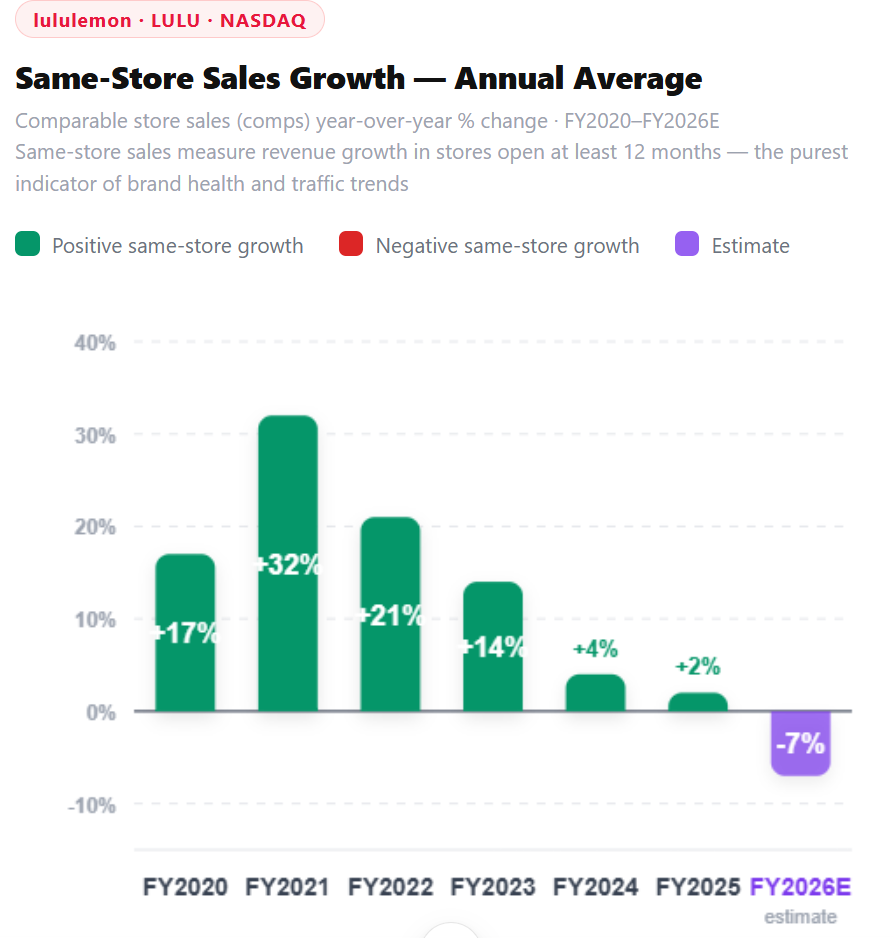
- Comp growth decelerated every year since the 2021 peak of +32% — down to +4%, then +2%, now an estimated -7%.
- This is the real issue to fix: stop the decline and get same-store sales growing again.
Total Store Count — Quarterly
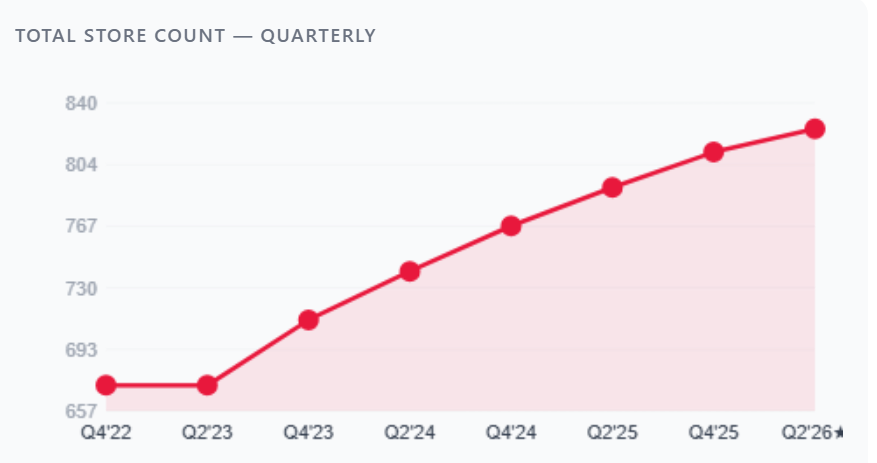
- Store count keeps rising, but it only tells you something when read together with the same-store sales trend above.
- Openings have continued steadily (roughly 670 to 825 stores) even as comps turned negative — expansion didn't pause for the demand slowdown.
Shares Outstanding — Annual (Millions)
- Shares outstanding have fallen sharply since 2016 — Lululemon pays no dividend but has bought back stock aggressively.
- Open question: does the buyback pace continue as earnings come under pressure.
US Athleisure Market Share — LULU vs. Competitors
- LULU gained market share through 2024 while Nike was losing share at the same time.
- In 2025 both started losing share, with a sharper forecast drop for LULU into 2026 — a sign this won't be an easy fix, even for a new CEO.
Now, back to the move itself. O'Neill spent 27 years at Nike, most recently running Consumer, Product & Brand. Under her watch, Nike leaned hard into direct-to-consumer and pulled back from wholesale partners. Many inside and outside the company now point to that shift as a root cause of Nike's ongoing struggles.
Now she's inheriting a business with an eerily similar profile. Lululemon's board rushed to name her CEO back in April after months of pressure from founder Chip Wilson and activist investor Elliott Management, but shares fell double digits the day of the announcement and have kept sliding since. A non-compete meant nearly a five-month gap with no permanent CEO — almost 300 days between her predecessor's exit and her first day. Q2 results didn't help the case: revenue down, comparable sales down double digits, North America down even harder, and full-year guidance cut twice. The stock is trading near an eight-year low.
So the real question isn't whether O'Neill is talented — she clearly is. It's whether a leader shaped by Nike's DTC-first, globally-scaled playbook is the right fit for a brand whose most urgent problem is a domestic, store-level demand crisis.
I have big expectations for O'Neill to turn this around. But the fact that even Nike — the bigger player — is losing market share too is a warning: this won't be an easy task for her either.
Wishing Heidi O'Neill the best of luck in this next chapter at lululemon.
#Lululemon #Nike #CEO #Retail #ExecutiveSearch #Leadership #ExecutiveHeadhunter.com